
Criminal Court Records in Stephens County
A criminal court record is the full case file the Court Clerk opens once charges reach the court. It is wider than a single arrest report. The file follows a case from the first charge through the final ruling. In Stephens County, these files sit with the District Court at the courthouse in Duncan. The record holds the charging document, bond terms, every docket entry, each hearing, the plea, the verdict or deal, and the sentence. A reader can trace the whole path of one case in one place. That breadth sets the court file apart from a booking sheet or a tip list.
Most state crimes in the county are heard by the Stephens County District Court. This trial court takes both felony and misdemeanor cases. Felony files carry a CF prefix, and misdemeanor files carry a CM prefix. The court also logs probable cause, search warrant, traffic, wildlife, and youthful offender matters under their own codes. City ordinance cases and Duncan traffic tickets are not District Court cases. Those go to the Duncan Municipal Court instead. For a closer look at the charges themselves, the Stephens County arrest records and court charges page breaks down how a charge is filed and changed.
Several criminal case types can show up in a Stephens County District Court search:
- Felony cases (CF) for the most serious offenses
- Misdemeanor cases (CM) for lower-level crimes
- Criminal probable cause filings
- Search warrant dockets when they are public
- Traffic crimes filed by information
- Youthful offender matters
The arrest and incident reports that often start a case do not sit in the court file. Those come from the Stephens County Sheriff's Office through the Stephens County Sheriff records request form.
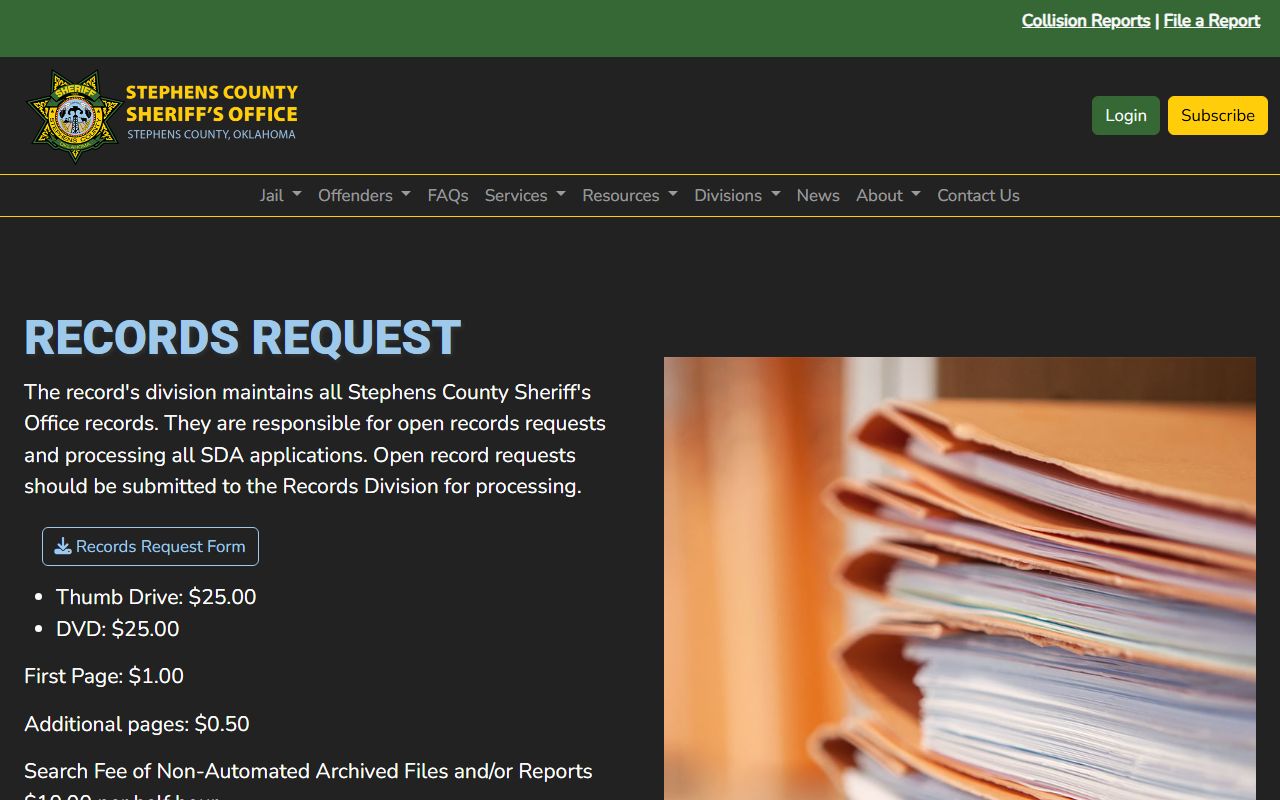
The form lists copy fees and the Oklahoma Open Records Act notice, so an arrest report and the matching court case file can be pulled from two separate offices.
Search Stephens County Criminal Court Records
Two free state systems hold most Stephens County District Court cases. The Oklahoma State Courts Network, known as OSCN, lists Stephens County District Court in its court menu. On Demand Court Records, known as ODCR, also lists Stephens in its court dropdown. Both let you search by name or case number with no account for a basic lookup.
- Open the OSCN docket search and pick Stephens County District Court from the County or Court menu.
- Search by the defendant's last and first name, or type a known case number such as a CF or CM file.
- Narrow the results by party type, case type, and a filed or closed date range.
- Open the case to read the docket, the charges, each hearing, and the disposition.
- Request a certified copy from the Stephens County Court Clerk at (580) 470-2000 when you need an official record.
If a case does not appear on OSCN, try ODCR with the court set to Stephens. For a statewide criminal history, the Oklahoma DOC offender lookup shows people held in state prison, though the agency warns its data is brief. Sealed, older, or restricted files may show only as a docket line and may need an in person visit to the clerk. Note: OSCN can show a turnstile check during heavy automated use, so a manual search by a real person works best.
Stages of a Stephens County Criminal Case
A criminal case moves through set steps, and each step leaves a mark in the record. The docket grows as the case moves. Reading the stages in order helps make sense of what a file shows. The flow below traces a typical felony or misdemeanor case in the District Court.
Case flow: Charges Filed › Arraignment › Pretrial / Motions › Plea or Trial › Disposition › Sentencing
| Stage | What Happens |
|---|---|
| Arraignment | The judge reads the charges and the defendant enters a first plea, usually not guilty at this early point. |
| Pretrial / Motions | Lawyers file motions, swap evidence, argue bond, and set dates; the docket logs each request and order. |
| Plea or Trial | The case ends in a plea deal or goes to trial before a judge or jury, who weigh the proof. |
| Sentencing | After a guilty plea or verdict, the court sets the penalty, such as jail, fines, costs, or probation. |
Note: the docket grows at each stage, so an open case can look different a week later as new entries post to the file.
The District Attorney's Role in Stephens County
An arrest does not file a case. The District Attorney does. Stephens County sits in District Attorney District 6, led by District Attorney Jason Hicks. His Stephens County office is in Room 303 of the courthouse in Duncan. The Oklahoma District Attorneys Council District 6 page lists the office and its role. District 6 also covers Caddo, Grady, and Jefferson counties.
Police and the sheriff gather facts and make arrests. The DA then decides what charges, if any, to file in court. That choice shapes the case file. The charging document the DA files is often called an information in Oklahoma. Once it is filed, the charges become part of the Stephens County District Court record and drive the rest of the case. A non-emergency event can be reported to the sheriff first, before any charge is weighed.
People can start that law enforcement step with the Stephens County non-emergency report form, which lists the offense types an officer can log.
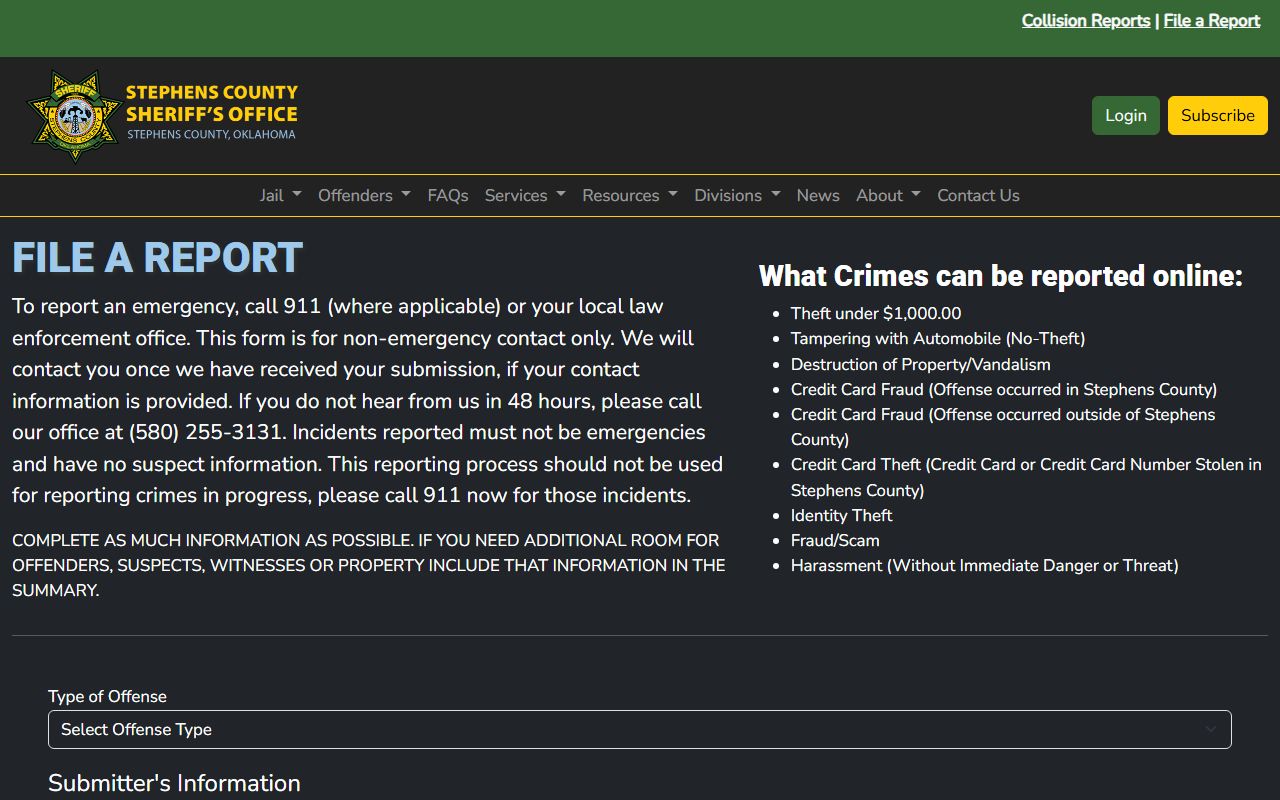
A report like this can lead to an arrest and, if the DA agrees, to a charge that opens a court case file.
What a Stephens County Criminal Record Shows
An Oklahoma docket file holds a long list of fields. Some name the people in the case. Others track money, dates, and the final result. Reading them in full keeps a single line from being read out of context. The table below maps the core fields in a Stephens County criminal court record.
| Field | What It Shows |
|---|---|
| Case Number | The court ID and prefix, such as CF for felony or CM for misdemeanor, plus the filing year. |
| Defendant | The accused person's name and party role in the case. |
| Charges | The crimes the District Attorney filed, with statute and severity level. |
| Plea | The defendant's formal answer: guilty, not guilty, or no contest. |
| Disposition | The case outcome, such as dismissed, convicted, acquitted, or deferred. |
| Sentence | The penalty set by the court, including jail, fines, costs, or probation terms. |
Other lines in the file can list the judge, the attorneys, bond amounts, each hearing date, and warrants. For the meaning of any prefix or code, read the full docket rather than guess from one tag. The broader set of Stephens County court records covers the civil, family, and probate files held by the same clerk.
Reading Dispositions in Stephens County Records
The disposition is the bottom line of a case. It tells you how the matter ended. Common results include guilty, not guilty, dismissed, and a no contest plea. Oklahoma also uses two outcomes that confuse many readers: the deferred sentence and the suspended sentence. A deferred case may be dismissed later if the person meets every condition. A suspended case keeps the conviction but holds back the time under set rules. Probation and revocation often appear next to these terms.
These words carry real weight, so a short glossary helps:
- Deferred sentence
- A plea where the court holds off on sentencing; the case may be dismissed if every condition is met.
- Suspended sentence
- A sentence that is imposed but held back under court terms.
- Probation
- Supervised release under rules set by the judge.
- Revocation
- A step to take back probation or a suspended or deferred sentence after a violation.
- Disposition
- The case outcome, such as dismissed, pled, convicted, or acquitted.
Note: a deferred or dismissed result still leaves a public court entry, so the case can show up in a search until it is sealed or expunged.
Charges vs. Convictions
Being charged is not the same as being found guilty. A charge is an accusation the state files. A conviction is the final finding after a plea or trial. A Stephens County criminal court record can hold charges that were dropped, dismissed, reduced, or that ended in an acquittal. Reading a charge as a conviction is a common and costly mistake. Always check the disposition before you draw a conclusion.
| Charge | Conviction | |
|---|---|---|
| Stage | Accusation | Verdict or plea |
| Burden of Proof | Probable cause | Beyond reasonable doubt |
| Public Record | Yes | Yes |
Public Access to Stephens County Criminal Records
Most criminal court files in Oklahoma are open to the public. The Oklahoma Open Records Act sets the base rule that people may inspect and copy government records during business hours. Law enforcement records, such as arrest and incident reports, fall under their own part of the Act. The Court Clerk handles court files, while the sheriff Records Division handles arrest and booking reports. Some files still stay sealed, redacted, or confidential by case type.
Key Statutes:
Oklahoma Statutes 51 O.S. § 24A.5 - sets the core rule that public records are open unless a law makes them confidential.
Oklahoma Statutes 51 O.S. § 24A.8 - makes law enforcement records open for public inspection, subject to set limits.
Sealed vs. Expunged Criminal Records
Oklahoma offers two main paths to limit a criminal record. A Section 18 expungement can seal an entire arrest record and the linked public court record when a person meets the rules in the law. A 991(c) expungement is narrower. It applies to a deferred sentence and changes the court disposition to "pled not guilty, case dismissed," but it does not remove the arrest record. The Oklahoma OSBI expungement guidance walks through both paths.
| Sealed | Expunged | |
|---|---|---|
| Visibility | Hidden from public | Treated as if it never existed |
| Law Enforcement | Limited access | Very limited |
| Eligibility | Court record under 22 O.S. § 991(c) for a deferred sentence | Full arrest and court record under 22 O.S. § 18 when the law allows |
Clearing the court record itself is free, but clearing the arrest record carries a $150 OSBI processing fee and may add local charges. Check eligibility through the court that handled the matter; the statute, not a website, sets who qualifies. Note: OSBI takes a cashier's check or money order for the fee and will not accept a personal check.
Restricted Criminal Records in Stephens County
Not every criminal file is open. Juvenile delinquency cases are restricted, even though juvenile codes appear in the court menus. Mental health proceedings and adoption files are closed too. Sealed and expunged matters drop out of public view by court order. Public dockets and request responses may also hide Social Security numbers, account numbers, minor names, and protected victim details.
Active search warrants can stay sealed until a court unseals them. A clerk or the sheriff may withhold juvenile, sealed, or open investigative material from a records request. When a record is held back, the court order behind it often falls under 51 O.S. § 24A.29, the part of the Open Records Act that lets a court seal pleadings and other court records.
Even when a file is limited, victims and the public can track an inmate's custody status through the Oklahoma Attorney General OK VINE service.
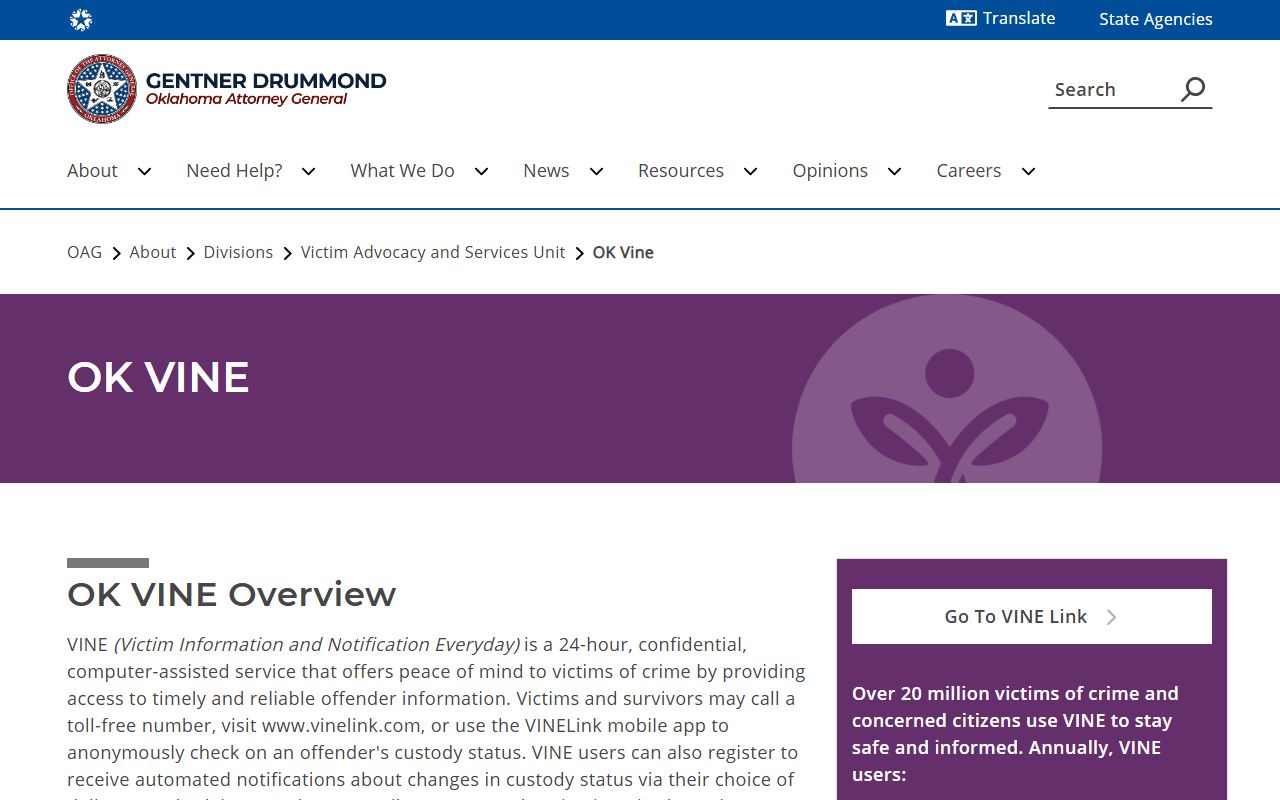
OK VINE sends free alerts by app, phone, email, or text when a custody status changes, which helps people follow a case after sentencing.
Background Checks and Stephens County Records
A casual court lookup is not a legal background check. Employers, landlords, and others who run formal screening must follow the federal Fair Credit Reporting Act. That law sets rules on accuracy, notice, and the right to dispute a result. A free docket search is fine for personal knowledge. It is not a substitute for a compliant report when a decision affects a job, a lease, or credit.
Important: The data shown here is not from a consumer reporting agency under the FCRA, and it may not be used for hiring, housing, credit, or insurance screening.